

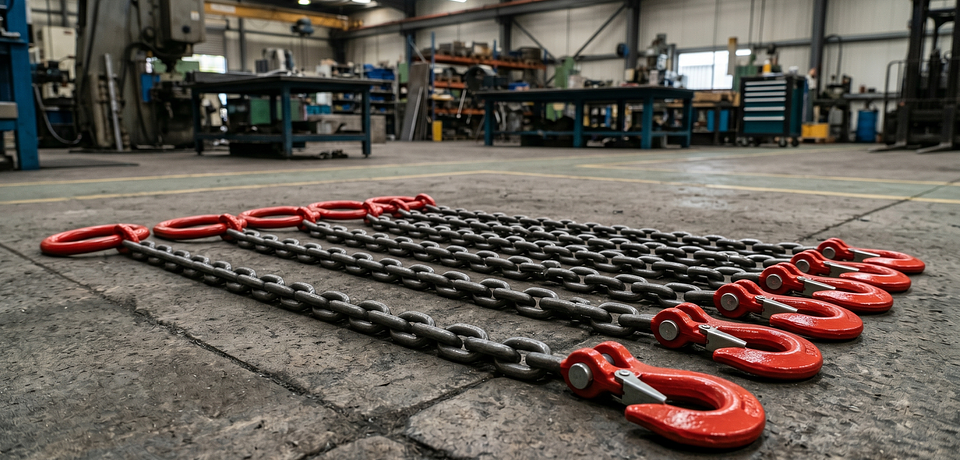
Grade 80 and Grade 100 — What's the Difference?
Amick fabricates alloy chain slings in two grades, each meeting specific manufacturing standards:
Grade 80 chain is manufactured to ASTM A391 specifications. It's widely used across general industrial lifting and remains the most common alloy chain grade in service today. Reliable, well-understood, and proven across decades of industrial use.
Grade 100 chain is manufactured to ASTM A973 specifications. Grade 100 provides approximately 25% higher working load limits than Grade 80 at the same chain diameter — delivering greater lifting capacity with less sling weight. The right choice when capacity needs increase but tool weight needs to stay manageable.
Welded and Mechanical Assemblies
Amick offers chain sling assemblies built two ways:
Welded assemblies feature welded coupling links permanently joining the chain to the master link and end fittings. The welded connection creates a smooth, secure assembly with no removable components in the load path.
Mechanical assemblies use mechanical coupling links to connect components. The mechanical connection allows individual components — chain sections, hooks, master links — to be replaced or reconfigured without rewelding the entire assembly. Practical for operations that need flexibility or anticipate component-level repairs over the sling's service life.
Configurations
Both Grade 80 and Grade 100 alloy chain slings are available in all standard leg configurations:
Single Leg (SOS) — A single chain leg with master link and end fitting. Used for vertical lifts.
Double Leg (DOS) — Two chain legs joined at a master link. Used for two-point lifts where balanced rigging is required.
Triple Leg (TOS) — Three chain legs for three-point lifts. Provides additional balance and load distribution across three pick points.
Quadruple Leg (QOS) — Four chain legs for four-point lifts. Maximum balance and stability for large, heavy, or irregularly shaped loads.
For three- and four-leg assemblies, rated loads are calculated assuming only two legs carry the load unless an engineering analysis confirms otherwise.
Hook Options
Amick fabricates chain slings with a full range of hook styles to match the application: plate, sling, foundry, grab, stirrup, and mold hooks. To discuss which hook style fits your application, contact Amick directly.
RFID-Ready for Inspection Tracking
Every Amick chain sling assembly is RFID-ready — enabling enhanced tracking and inspection management. Critical for compliance programs managing large fleets of lifting equipment.
Pair with No-Touch Tools for Safer Rigging
Chain slings are heavy, rigid, and unforgiving when they swing or shift during a lift. Positioning a chain sling around a load, threading it through a lift lug, or guiding a suspended chain into the right angle all create moments where hands are dangerously close to a moving load. Amick's no-touch tools are purpose-built for exactly these situations — letting workers push, pull, and guide chain slings into position from a safe distance. The C Head, J Head, and S Head are particularly well-suited for engaging chain slings during rigging and load positioning.
Built to Last, Built to ASME B30.9
All Amick chain sling assemblies are proof tested and built with a 4:1 design factor in accordance with ASME B30.9 and OSHA requirements. Both Grade 80 and Grade 100 alloy chain slings maintain full rated capacity up to 400°F (205°C). Above 400°F, rated loads must be reduced per the manufacturer's derating chart.
Alkalies and strong acids are harmful to alloy chain material — consult Amick before use in chemically aggressive environments. Do not use chain slings with visible damage including stretched, bent, twisted, or cracked links. Periodic documented inspections are required at intervals not exceeding 12 months per ASME B30.9.
Custom Built in Pittsburgh
Every chain sling is fabricated at Amick's Pittsburgh facility. Don't see exactly what you need? Sketch it and we'll make it.
To discuss your chain sling requirements, contact Amick at 412-429-1212 or visit our alloy chain slings page.