

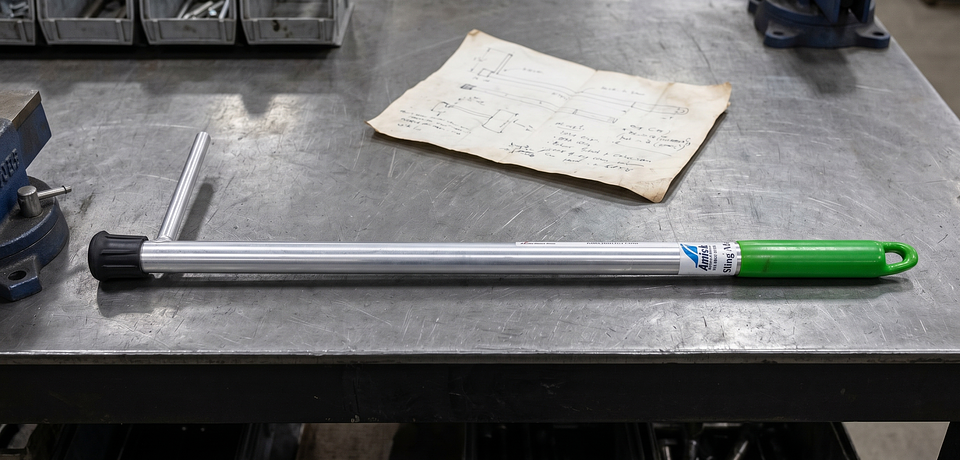
Signs You Need a Custom Tool
Most custom tool requests start with the same realization — a worker reaches for a standard tool, and it either can't engage the load properly or puts them in a position that isn't safe. Here are the most common triggers:
Unusual load geometry — Loads that are irregular in shape, asymmetrical, or have attachment points in locations that standard head types can't reach or engage cleanly. A hook that works perfectly on a flat plate may be completely wrong for an oddly shaped fabricated component with a recessed lift point.
Unique reach requirements — Jobs that require a specific shaft length, bend, or offset that doesn't exist in the standard catalog. Sometimes the geometry of the lift means the worker needs to engage at a distance or angle that no off-the-shelf tool accommodates.
Specialized engagement points — Load attachment points, lift lugs (metal tabs or plates welded to the load specifically for lifting and attachment), or sling configurations that don't match any standard head profile. If the contact point is unusual, the head needs to be designed around it rather than the other way around.
Irregular load materials or surfaces — Loads with surfaces, coatings, or material properties that require a specific contact approach to avoid damage or slippage. Standard steel or aluminum heads may not be appropriate for every material type.
Application-specific requirements — Operations where standard tool dimensions, materials, or configurations simply don't work — whether that's clearance, weight, reach, or the nature of the load handling task itself.
How to Request a Custom Tool
The process starts with describing the problem, not the tool. Amick's team works backward from the challenge to design a solution — so the most useful thing a customer can provide is a clear picture of what they're trying to do and why standard options aren't working.
Here's what helps most:
A sketch or description of the load — What does it look like? What shape is it? Where are the attachment or contact points? A rough hand sketch is enough to get started — it doesn't need to be an engineering drawing.
The engagement point — Where does the tool need to contact the load? Is it a flat surface, a lift lug (a metal tab or plate welded to the load specifically for lifting and attachment), a chain sling, a web sling, or a tube end? The more specific, the better.
The environment — Is this an overhead crane operation? A hoist? Ground-level material handling? Are there clearance constraints or reach requirements that affect tool dimensions?
What the tool needs to do — Push, pull, position, guide, or some combination? One direction or both? Does rigidity matter, or is flexibility acceptable?
The more detail provided upfront, the faster Amick can turn around a design. But even a rough description of the problem is enough to start a conversation.
What Happens Next
Once Amick has enough information, the design and fabrication happen in-house at the Pittsburgh facility. There are no outside vendors, no subcontracted manufacturing — the same team that builds Amick's standard no-touch tool lineup builds the custom tools. That means the quality, materials, and construction standards are identical to every other tool that comes out of the shop.
Lead times vary by complexity, but the process is straightforward: describe the problem, review the proposed solution, and receive a tool built specifically for the job.
Your Problem Is the Starting Point
Amick's standard lineup covers the majority of load handling scenarios — but the custom capability is what sets the operation apart. If a standard tool isn't solving the problem, that's not a dead end. It's the beginning of a conversation.
Describe your challenge to the Amick team at 412-429-1212 or email us from the button below and we'll get back to you right away.