

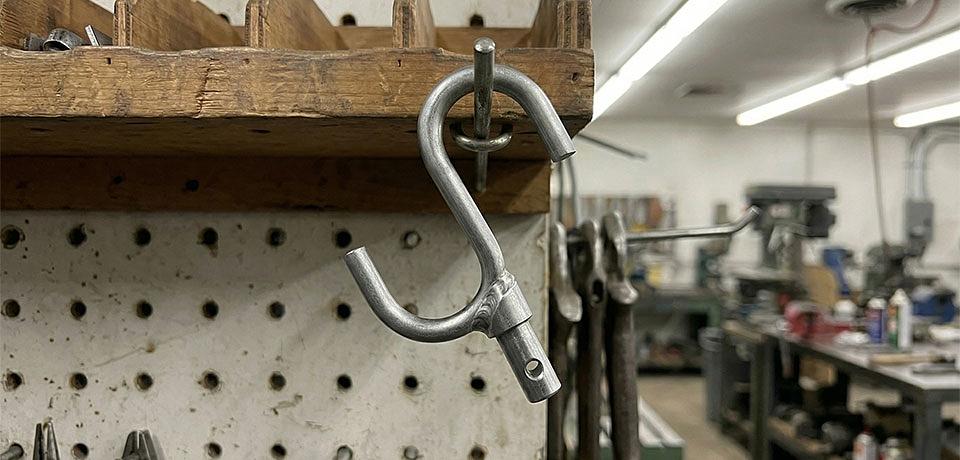
How the S Head Works
The S Head gets its name from its shape — two opposing curves forming an S profile, with an open hook on each end. Where the J Head commits to a single direction of engagement and the C Head works best with a clear approach, the S Head offers two engagement points on the same tool. A worker can hook onto a rigging component from whichever end provides the best angle for the task, then push or pull as needed.
That two-directional geometry makes it particularly useful in situations where rigging access is limited or where the worker's position relative to the load changes during the lift.
What It Contacts
The S Head is designed for push and pull engagement with:
Loaded sling mediums — Pushing or pulling wire rope, chain, or synthetic slings into position on a suspended load from whichever approach angle is available.
Chain — Controlling and repositioning chain slings during a lift, adjusting drape or angle without hand contact near the load.
Wire rope — Engaging wire rope slings to push or pull them into the correct position during rigging without putting hands near the tension point.
Synthetic slings — Guiding web or round slings into position on a load where direct hand contact would put workers at risk.
Rigging hardware — In some applications, engaging hardware components where the double-ended profile provides a better grip angle than a single hook would allow.
Available Configurations
Amick builds the S Head in both steel and aluminum construction across multiple lengths:
Steel S Head Tools — Heavy-duty steel construction with bicycle handle, available in multiple lengths for demanding industrial environments where strength and reach are both priorities.
Aluminum Fixed Head Tools — Lightweight aluminum pole with fixed S Head, available in multiple lengths for jobs where reduced tool weight matters over a long shift.
Aluminum Removable Head Tools — Same lightweight aluminum construction with the flexibility to swap the S Head for a different head type as job requirements change. Available in multiple lengths.
When to Reach for the S Head
The S Head is the right call when access to the rigging is limited or the approach angle isn't ideal for a single-ended hook. Its double-ended profile gives workers options — engage from whichever end fits the situation, then push or pull as the job requires. For straightforward pull engagement, the J Head remains the cleaner choice. But when the geometry of the job makes a single hook impractical, the S Head's flexibility is what gets it done.
Part of a Larger System
The S Head is the fourth article in Amick's no-touch tool head type series. Each head type is designed for specific contact points and applications — choosing the right one for the job is what makes no-touch tools effective rather than just present on the job site.
To discuss which configuration fits your operation, contact Amick at 412-429-1212 or click on the button below.