

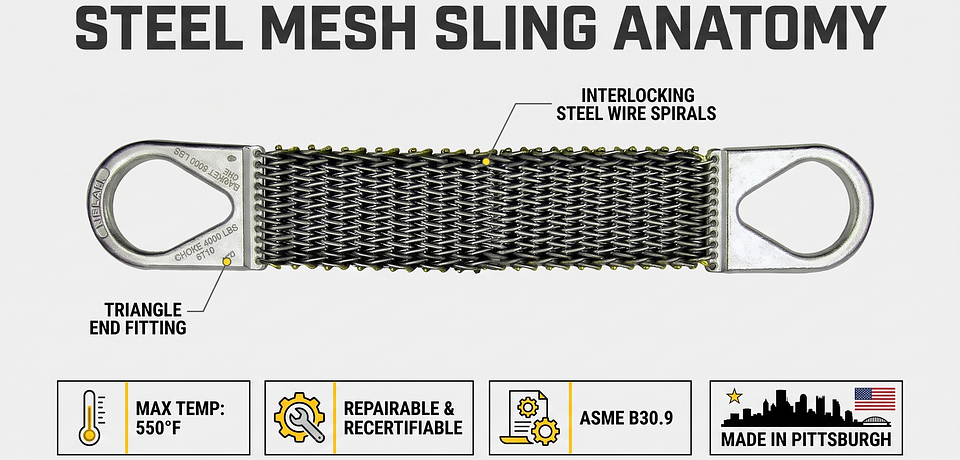
How Steel Mesh Slings Work
A steel mesh sling is constructed from a continuous, interwoven pattern of steel wire that forms a flat, flexible sling body. The mesh distributes the load across many points of contact rather than concentrating it on a single rope or webbing surface. The result is a sling that conforms to the load like fabric while delivering the strength, abrasion resistance, and heat tolerance of steel.
End fittings on each end of the sling body provide the attachment point for hooks, master links, or rigging hardware.
Where Steel Mesh Slings Are Used
Steel mesh slings are the right choice in environments where other sling types simply won't survive:
Foundries and metal casting operations — High temperatures, hot castings, and abrasive surfaces that would burn or shred synthetic slings.
Steel mills — Hot rolled product, sharp plate edges, and abrasive scale that quickly degrade wire rope and synthetics.
Forging and heat treating — High-temperature loads and rough surfaces that demand a sling built for thermal and abrasion exposure.
Metalworking and fabrication shops — Sharp edges, weld spatter, and rough handling that damage other sling types quickly.
Bundle and coil handling — Where the sling needs to conform around a load while resisting cutting from edges or rough material.
Temperature Limits
Steel mesh slings are built for heat — but they have a ceiling. Carbon steel mesh slings should not be used at temperatures above 550°F (288°C). For applications that approach or exceed that limit, consult Amick for the appropriate sling specification.
Repairable and Recertifiable
What sets Amick's steel mesh sling capability apart is the ability to repair and recertify slings rather than replace them. Wire mesh sling repair is a specialty service offered by only a handful of facilities in the country.
Per ASME B30.9, any single broken wire in a mesh sling body is cause for removal from service — but a qualified repair can restore the sling to full rated capacity. Amick's repair process includes replacement of damaged mesh sections, end fitting repair and replacement, and complete load testing and recertification after repair. For operations running large fleets of steel mesh slings, the ability to repair rather than replace can deliver significant cost savings over the equipment's service life.
Pair with No-Touch Tools for Safer Handling
Steel mesh slings are often used in environments where the load itself is hot, sharp, or hazardous — exactly the conditions where direct hand contact during rigging is most dangerous. Amick's no-touch tools let workers position, push, and pull steel mesh slings into place from a safe distance, keeping hands away from hot castings, sharp plate edges, and pinch zones that come with heavy industrial lifting.
Inspected to OSHA and ASME B30.9
All Amick steel mesh slings are fabricated, inspected, and tested in accordance with OSHA 1910.184 and ASME B30.9. Periodic documented inspections are required at intervals not exceeding 12 months, with more frequent inspections in heavy or severe service. Removal-from-service criteria include broken wires, kinks or distortions in the mesh body, damage to end fittings, and excessive wear or corrosion.
Built and Repaired in Pittsburgh
Every steel mesh sling Amick fabricates is built at the Pittsburgh facility, and the same team handles wire mesh repair and recertification of damaged slings — including slings from any manufacturer, not just those originally built by Amick.
To discuss a steel mesh sling fabrication or repair, contact Amick at 412-429-1212.