

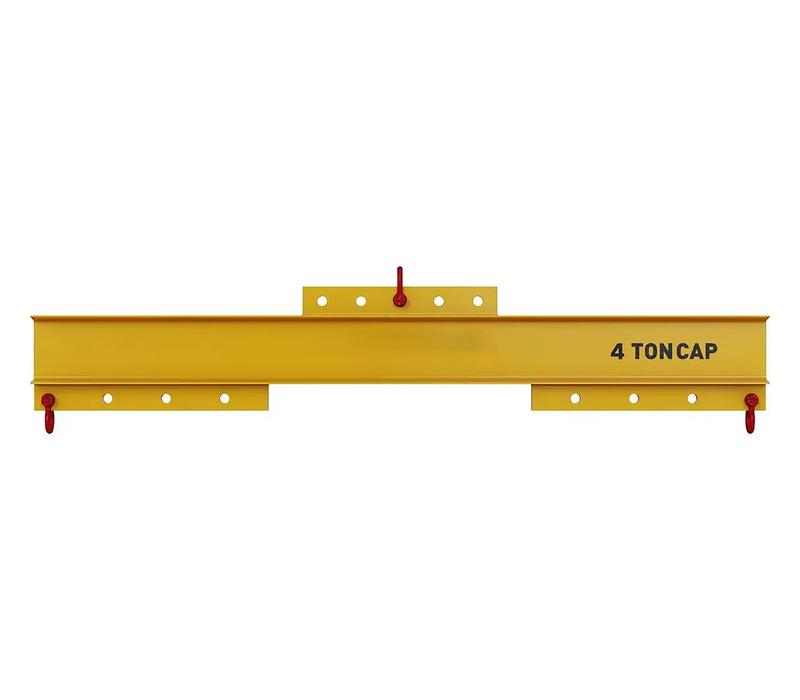
Spreader Bars are below-the-hook lifting devices designed to distribute load weight across a wide span by separating the sling legs at the load attachment points. Unlike lifting beams — which carry the load in bending from a single center pick point — spreader bars carry the load primarily in compression, with angled sling legs running from the crane hook down to each end of the bar.
This compression-based design allows spreader bars to handle wide loads efficiently while keeping headroom requirements to a minimum. The angled top rigging transfers the load through the bar as axial compression, making spreader bars structurally efficient for their weight. However, because the bar is loaded in compression, it must be engineered for buckling resistance — a critical design consideration addressed by ASME BTH-1.
Spreader bars are commonly used for lifting wide, long, or distributed loads where sling angles would become dangerously low without the bar spreading the pick points apart. They are essential when headroom is limited or when the load requires wide-span support to prevent bowing or deflection.
All spreader bars supplied by Amick are designed in accordance with ASME BTH-1 and comply with ASME B30.20 requirements. Each bar is proof tested at 125% of rated capacity.
Wide-span load distribution — spreader bars engineered and proof tested to ASME standards. Call 412-429-1212.
Type
Compression-loaded spreader bars with top rigging and load attachment points. ASME B30.20 Certified and approved below the hook lifting devices of all types.
Applications
Construction, steel erection, bridge work, precast concrete, mechanical installation, power generation, petrochemical, and heavy industrial lifting. Used wherever loads require wide pick point spacing, where sling angles would be too low without spreading, or where limited headroom prevents the use of a standard lifting beam.
Exceptions
Do not exceed rated capacity. Spreader bars and lifting beams are NOT interchangeable — they carry loads differently (compression vs. bending) and cannot be substituted without complete engineering re-analysis. Ensure top rigging sling angles match the rigging diagram supplied with the bar. Inspect for cracks, buckling, permanent deformation, and corrosion before each use. Annual periodic inspections required per ASME B30.20. Do not modify, drill, or weld without manufacturer approval.