

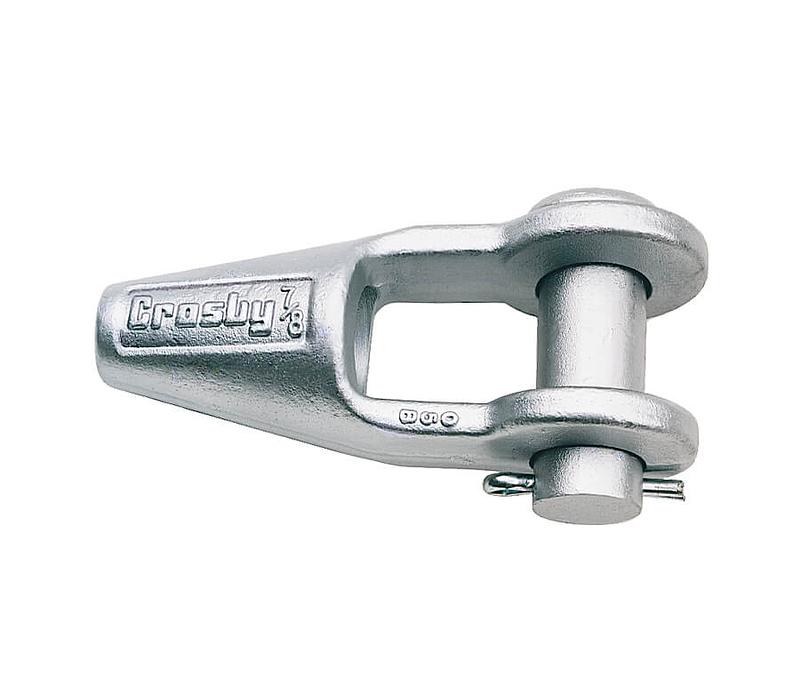
End Fittings, Swage Sockets, and Spelter Sockets are permanent wire rope terminations that provide the highest connection efficiency — retaining a greater percentage of the wire rope's rated breaking strength than clips or other field-fabricated connections.
Swage sockets are attached by mechanically pressing (swaging) a metal sleeve onto the wire rope using a hydraulic press, creating a permanent, compact termination. They are fast to fabricate and provide consistent, reliable performance.
Spelter sockets (also called poured or zinc sockets) are attached by inserting the wire rope into a conical socket body, brooming out the individual wires, and filling the socket with molten zinc or resin. This method produces the strongest possible termination — approaching 100% of the wire rope's rated strength — and is the preferred choice for critical and high-capacity applications.
Both termination types require proper tooling, training, and quality control. Improperly swaged or poured sockets can fail without warning.
Amick fabricates wire rope assemblies with swage and spelter socket terminations at our Pittsburgh facility.
Maximum connection strength — swage and spelter socket terminations fabricated in Pittsburgh. Call 412-429-1212.
Type
Swage (mechanically pressed) sockets and spelter (zinc/resin poured) sockets. Open and closed body configurations.
Applications
Crane cable terminations, wire rope sling fabrication, guy wire terminations, bridge cable assemblies, and any wire rope application requiring the highest possible connection efficiency. Spelter sockets are preferred for critical and high-capacity applications.
Exceptions
Swage and spelter socket fabrication must be performed by qualified personnel using proper tooling and procedures. Inspect for cracks in the socket body, proper seating of the wire rope, and signs of wire rope pull-out. Spelter sockets must show no evidence of zinc or resin deterioration. After any evidence of overloading, have the assembly inspected by a qualified person before returning to service.