

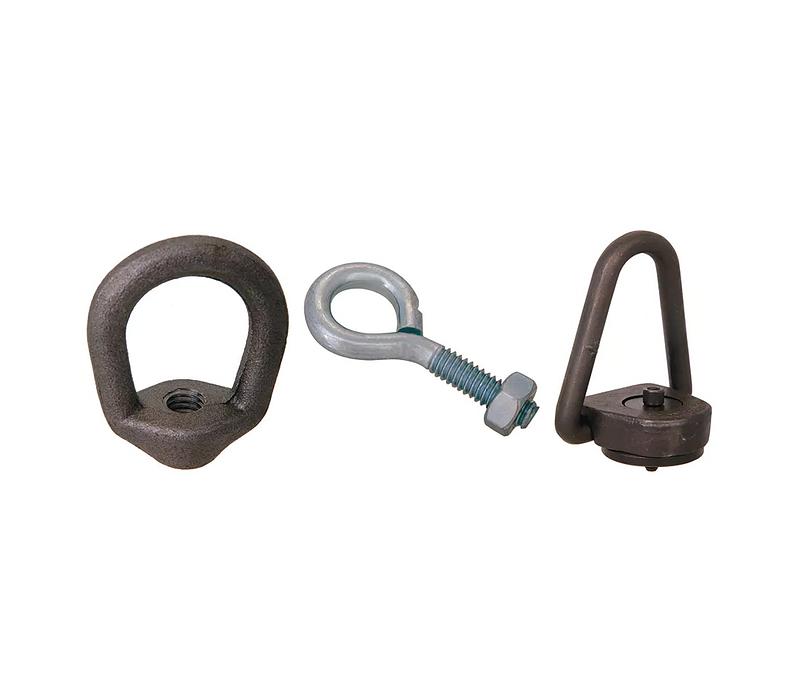
Eye Nuts, Pad Eyes, and Hoist Rings are permanent or semi-permanent rigging attachment points installed on equipment, machinery, and structures to provide dedicated lifting connections.
Eye Nuts thread onto a bolt or stud to create a lifting point, functioning similarly to eye bolts but with the versatility of being installed on existing hardware. Like eye bolts, standard eye nuts are rated for vertical loading only.
Pad Eyes are welded-on attachment points — steel plates with a hole for accepting a shackle or pin, permanently welded to the structure or equipment being lifted. Pad eye design and welding must be performed by a qualified person, as the weld and base material must support the full rated load.
Swivel Hoist Rings are the most versatile option — they pivot and rotate under load, automatically aligning with the direction of pull regardless of the sling angle. This eliminates the angular loading restrictions that limit standard eye bolts and eye nuts, making hoist rings the preferred choice for multi-directional and angled loading.
All adjustable hardware in this category must be proof tested at a minimum of 2 times rated load per ASME B30.26. Amick stocks these products from our Pittsburgh facility.
Dedicated lifting points that handle any angle — hoist rings, eye nuts, and pad eyes from Amick. Call 412-429-1212.
Type
Eye nuts, welded pad eyes, and swivel hoist rings. Proof tested at 2x rated load per ASME B30.26 (adjustable hardware).
Applications
Providing permanent and semi-permanent lifting points on machinery, equipment, molds, dies, structural steel, vessels, and any component requiring dedicated rigging attachment. Swivel hoist rings are preferred for applications involving multi-directional or angled loading.
Exceptions
Standard eye nuts are rated for vertical loading only — use swivel hoist rings for angular or multi-directional loading. Pad eyes must be designed and welded by a qualified person with adequate weld and base material strength. Swivel hoist rings must rotate and pivot freely — do not use if the swivel mechanism is damaged, seized, or contaminated. Inspect all attachment points before each use. Annual documented inspections required per ASME B30.26.