

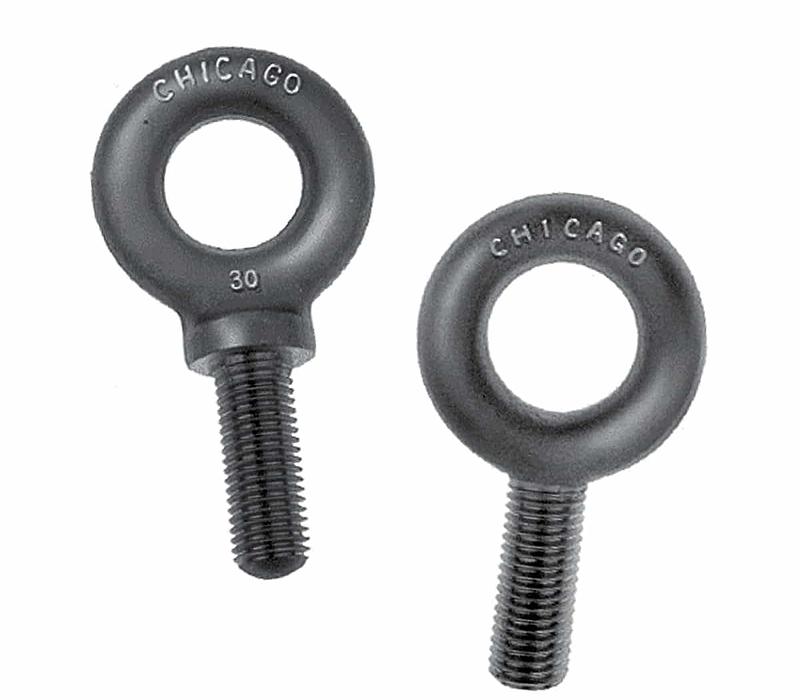
Forged Eye Bolts provide a threaded anchor point for attaching rigging to machinery, structural steel, and other equipment with tapped holes. The forged eye accepts shackles, hooks, or slings, creating a secure lifting point that can be installed wherever a threaded connection is available.
Eye bolts are classified as adjustable hardware under ASME B30.26 and must be proof tested at a minimum of 2 times their rated load. A critical safety consideration: standard shoulder-type eye bolts are rated for vertical (in-line) loading only. Angular loading significantly reduces capacity — and loading perpendicular to the plane of the eye (side loading) can cause the bolt to bend or fail catastrophically. For angular or multi-directional loading, use swivel hoist rings instead.
Shoulder eye bolts must be seated flush against the mounting surface with the shoulder in full contact — if the bolt cannot seat flush, shims must be used to fill the gap. Never use a nut as a spacer.
Amick stocks forged eye bolts from our Pittsburgh facility.
Threaded lifting points where you need them — forged eye bolts stocked in Pittsburgh. Call 412-429-1212.
Type
Forged shoulder eye bolts. Threaded installation. Proof tested at 2x rated load per ASME B30.26.
Applications
Providing lifting and rigging anchor points on machinery, equipment, structural steel, molds, dies, and any component with tapped holes. Used in manufacturing, plant maintenance, machine installation, and construction.
Exceptions
Standard shoulder eye bolts are rated for vertical (in-line) loading only — angular and side loading drastically reduce capacity. The shoulder must seat flush against the mounting surface. Never use a nut as a spacer. For angular or multi-directional loading, use swivel hoist rings instead. Ensure the threaded engagement is adequate for the load. Inspect for cracks, thread damage, and shoulder contact before each use. Annual documented inspections required per ASME B30.26.