

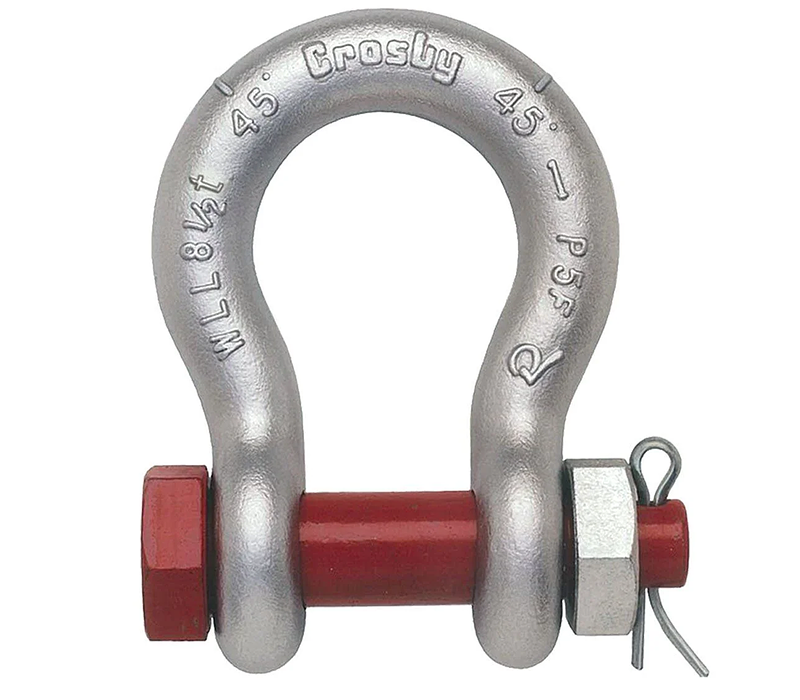
Forged Shackles are the most common connecting link in rigging — used to join slings, wire rope, chain, and other rigging components to each other and to the load. Available in anchor (bow) and chain (D-type) configurations, shackles are forged from alloy or carbon steel and are available with screw pins or bolt/nut/cotter pin closures.
Anchor shackles have a rounded bow that accommodates multiple slings or wide-body fittings, while chain shackles have a narrower D-shape suited for single in-line connections. Both types must be loaded in-line whenever possible — side loading significantly reduces capacity. Per ASME B30.26, side loading at 6–45° reduces the rated load by 30%, and side loading at 46–90° reduces it by 50%. Loading over 90° is not recommended.
When multiple slings are placed in the body of a shackle, the included angle between the slings must not exceed 120°. Always use the marking on the shackle body to identify the working load limit — never rely on the pin marking alone, as pins from different shackle sizes may appear similar.
Amick stocks forged shackles from premium manufacturers at our Pittsburgh facility.
The most critical connection in your rigging — forged shackles stocked in Pittsburgh. Call 412-429-1212.
Type
Anchor (bow) shackles and chain (D-type) shackles. Screw pin and bolt/nut/cotter configurations. Forged alloy and carbon steel.
Applications
Every rigging application requiring a detachable connection between slings, wire rope, chain, hooks, master links, and other rigging components. Used across all industries including construction, manufacturing, steel erection, energy, marine, and general industrial lifting.
Exceptions
Side loading reduces shackle capacity: 6–45° = 30% reduction; 46–90° = 50% reduction; over 90° = not recommended per ASME B30.26. Multiple slings in the shackle body must not exceed 120° included angle. Never use a shackle with a missing, bent, or undersized pin. Inspect for cracks, distortion, excessive wear, corrosion, and pin condition before each use. Annual documented inspections required per ASME B30.26.