

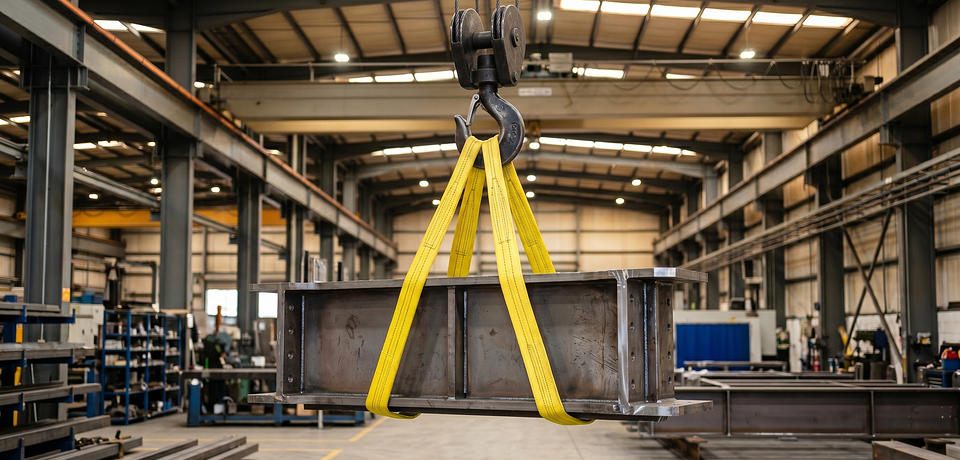
Nylon vs. Polyester — Choosing the Right Material
Every synthetic web sling configuration Amick manufactures is available in both nylon and polyester. The choice between them comes down to the application environment.
Nylon offers approximately 8–10% elongation at rated capacity, making it effective at absorbing shock loads and reducing the risk of sudden load drop. It's the better choice for general lifting where some stretch is acceptable. The tradeoff: nylon loses approximately 15% of its rated capacity when wet, and is susceptible to damage from acids and bleaching agents.
Polyester offers approximately 3% elongation — significantly less than nylon — providing tighter load control and more predictable positioning during a lift. It maintains its full rated capacity when wet and resists acids and bleaching agents. The tradeoff: polyester is susceptible to damage from strong alkalis.
Both materials resist moisture, mildew, and rot. Neither should be used in temperatures above 194°F (90°C) or below -40°F (-40°C).
Eye & Eye Flat Web Slings (Type 3)
The most widely used synthetic sling configuration in industrial lifting. A flat eye is sewn into each end of the webbing body, creating a secure and versatile attachment point for hooks, shackles, and other rigging hardware. The flat eye design is easy to position on crane hooks and easy to remove from beneath a load once set. Available in 1-ply, 2-ply, 3-ply, and 4-ply in widths from 1" to 12" with custom lengths available.
Compatible with vertical, choker, and basket hitches. The wide, soft bearing surface distributes load pressure across the full width of the webbing, reducing the risk of damage to finished or delicate surfaces.
Eye & Eye Twist Web Slings (Type 4)
Constructed identically to the flat eye sling with one key difference — the eyes are turned 90° so they sit perpendicular to the sling body. This twisted orientation allows the eyes to nest naturally into crane hooks and shackles, providing a more secure and stable seat than a flat eye. Particularly useful in choker hitch applications where the perpendicular orientation allows the eye to wrap cleanly around the hook without folding or bunching.
Available in 1-ply and 2-ply in widths from 1" to 12" with custom lengths available. Compatible with vertical, choker, and basket hitches.
Endless Web Slings (Type 5)
Constructed by overlapping and sewing fabric into a continuous loop — no separate eyes, no end fittings. The result is a sling that can be used at any point along its circumference, making it highly versatile for load positioning. Areas of hook contact can be tapered and reinforced to extend service life in demanding environments. Compatible with vertical, choker, and basket hitches.
Reversed Eye Web Slings
A heavy-duty construction where the webbing is folded back and sewn side by side to form the eye, rather than simply folded over and stitched flat. This creates a reinforced, wider eye that sits at 90° to the sling body — similar in orientation to a twisted eye but with a more robust bearing surface. The reversed eye construction provides enhanced load distribution at the connection point and increased durability in the eye area, making these slings well suited for demanding applications where standard flat or twisted eyes would wear too quickly.
Triangle-Choker Web Slings (Type 1)
Feature metal end fittings — a triangle fitting on one end and a choker fitting on the other. Purpose-built for choker hitch applications, where the sling wraps around the load and the choker end passes through the triangle to form a secure grip. The metal fittings protect the webbing from abrasion at the connection points — the areas where synthetic slings experience the most wear — extending service life in repetitive choker hitch applications. Available in nylon and polyester. Also suitable for vertical and basket hitches.
Triangle-Triangle Web Slings (Type 2)
Feature metal triangle fittings on both ends of the webbing body. Designed primarily for basket hitch and vertical hitch applications where secure, consistent hardware connections are required at both ends. The dual triangle fittings provide efficient, straight-line lifting with clean hardware connections to hooks and shackles. Note: the dual triangle configuration does not allow the sling to pass through itself — these slings cannot be used in a choker hitch.
Wide Lift Basket Web Slings
Specialty slings designed for basket hitch applications where a wide bearing surface is required for load stability and surface protection. The extra-wide body distributes the load across a larger contact area, reducing pressure on the load and providing a stable, secure platform during lifting. Available in light-duty configurations for cargo handling and packaging, and heavy-duty versions for industrial loads requiring both wide surface contact and high working load limits. Designed for basket hitch use only — not for vertical or choker hitches.
UltraWeb Slings
Amick's high-performance web sling option, made from one of the strongest abrasion-resistant materials available for synthetic lifting applications. Where standard nylon or polyester webbing wears too quickly in harsh environments, UltraWeb provides significantly greater resistance to abrasion, cutting, and surface damage. UltraWeb slings deliver the benefits of a synthetic web sling — lightweight, flexible, non-marring — with durability that approaches wire rope slings in abrasive environments. The right choice when standard web slings are wearing out too fast but wire rope or chain would be too heavy, too rigid, or too damaging to the load surface.
What Every Synthetic Web Sling Has in Common
Regardless of configuration or material, every synthetic web sling Amick manufactures shares the same baseline requirements: built with a 5:1 design factor, inspected per OSHA 1910.184 and ASME B30.9 criteria, and manufactured at the Pittsburgh facility. Edge protection or wear pads should always be used when lifting loads with sharp edges. Any sling showing visible cuts, fraying, chemical damage, or UV degradation should be removed from service immediately.
Custom lengths, widths, and ply counts are available across all web sling configurations. To discuss your specific lifting application, contact Amick at 412-429-1212.