

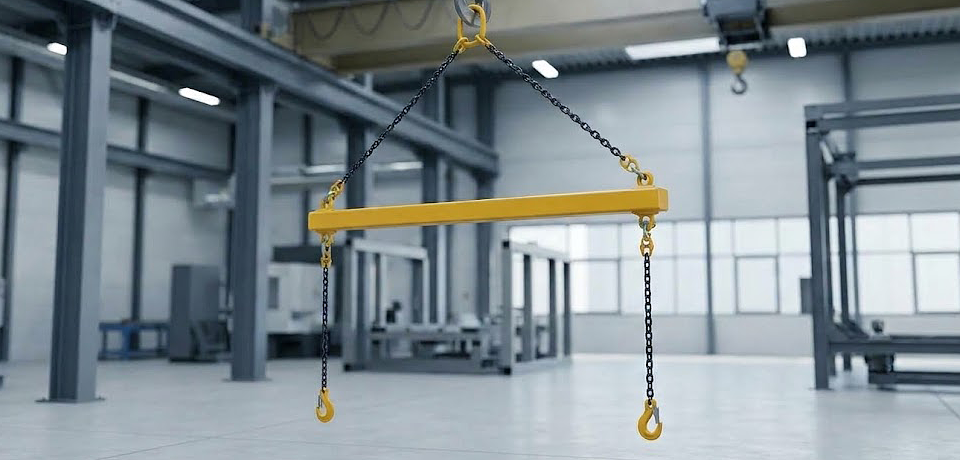
Long loads, wide loads, coils, and steel plate each call for a different below-the-hook device. Amick supplies a full range of lifting beams and below-the-hook lifting devices, from standard beams for everyday lifting to custom-engineered solutions for unique load challenges. Every device is designed and manufactured in accordance with ASME B30.20 and ASME BTH-1.
Lifting Beams
Standard Beams — Standard lifting beams are the most common below-the-hook lifting device used in industrial operations. They attach to a crane or hoist at a single center pick point and support the load from two or more points along the beam's length. By spreading the load across multiple pick points, lifting beams reduce sling angles, improve load stability, and minimize the risk of load tipping or swinging during a lift.
Multi-Purpose Adjustable Beams — Adjustable beams have pick points that slide along the beam and lock into position. That lets a single beam handle multiple load widths and lifting geometries, so a facility doesn't have to stock separate beams for different load sizes. Rated capacity changes with pick point spacing, so always confirm the rated load for the configuration in use.
Tandem Two Hoist Beams — Tandem beams are engineered for lifts that require two cranes or hoists working together on a single load. They distribute the load between two hoisting points for long, heavy, or oversized loads that exceed the capacity or reach of a single crane. Tandem lifts require a qualified lift plan and coordination between crane operators.
Spreader Bars
Spreader bars distribute load weight across a wide span by separating the sling legs at the load attachment points. A lifting beam carries the load in bending from a single center pick point. A spreader bar carries the load primarily in compression, with angled sling legs running from the crane hook down to each end of the bar. That design keeps headroom requirements to a minimum. It makes spreader bars the right choice when sling angles would otherwise be too low or when headroom is limited.
One important point from Amick's own guidance: spreader bars and lifting beams are not interchangeable. They carry loads differently and cannot be substituted for one another without a complete engineering re-analysis.
Coil and Sheet Handling
For steel and metals handling, Amick supplies devices built for specific material shapes:
C-Hooks — C-hooks slide into the inner diameter of a horizontally oriented coil. Their open shape lets the operator engage and release the coil quickly, which makes them one of the fastest coil handling methods available. They are counterbalanced to hang level whether loaded or empty. C-hooks are passive devices with no mechanical locking mechanism, so the operator is responsible for proper coil engagement throughout the lift.
Coil Lifters — Coil lifters grip and lift coils from the vertical or angled position, inserting into the coil's inner diameter and securing the load mechanically. That mechanical grip gives the operator greater control and reduces the risk of load disengagement compared to passive lifting methods.
Telescoping Sheet Lifters — Telescoping sheet lifters have a span that adjusts to the width of the sheet being lifted. That lets the pick points sit at the right spacing for each sheet and prevents the load from bowing, flexing, or tipping. They typically use lifting clamps, magnets, or vacuum pads at the pick points. Amick offers horizontal, horizontal-to-vertical, and vertical-only types.
Tested and Marked to ASME Standards
Every below-the-hook device must be proof tested at 125% of its rated capacity. It must be permanently marked with the manufacturer's name, serial number, rated load, and ASME BTH-1 design category and service class. Amick ensures full compliance with these requirements on every device it supplies. Annual periodic inspections are required under ASME B30.20.
Inspection, Testing, and Repair
Beyond supply, Amick provides inspection, load testing, recertification, and repair services for below-the-hook lifting devices. These services keep equipment compliant and safe throughout its service life. Amick's five certified inspectors bring over 150 years of combined rigging experience to every evaluation.
Whether you need an off-the-shelf beam or a custom-engineered lifting solution, contact Amick at 412-429-1212 or visit our lifting beams and devices page for more info.